

🎯 Today’s Mission:
To successfully complete today’s mission:
- ✅ XYZ.
- ✅ Complete the form at the bottom of the page when done.
- 🔗 [OPTIONAL] Share with us, in the 21-Day Mindset Challenge FB Support Group, how today’s mission is going for you.
💡 More Info:
Trying to be perfect is the enemy of progress.
Why? Because nobody is perfect, which means that kind of approach is doomed to fail.
It’s not the single perfect daily action that transforms your life, it’s the lifetime of consistent and repetitive daily actions moving you towards your goals that do.
- The person who does 100 average workouts in a year is far better off than the person who does 10 perfect ones.
- The person who eats 50 reasonably healthy meals in a month is far better off than the person who eats 5 perfect ones.
Many people who see themselves as “perfectionists” try to come up with the perfect plan to follow that requires the perfect conditions in life – and then as soon as things don’t go their way they crash and burn.
It’s far more important to develop the kind of mindset that allows you to be flexible and seek incremental improvement rather than only seeing perfection or failure.
Let’s talk about “all-or-nothing thinking” versus “thinking on a continuum”.
😇 All-or-nothing 👿 thinking
All-or-nothing thinking is when you tend to only think in extremes, two polar opposites, or two mutually exclusive either-or-choices.
- “If I don’t have time to do a full 60-minute workout, I might as well do nothing at all.“
- “If I break my meal plan and eat chocolate, there’s no sense in sticking to the plan for the rest of the day. In fact, this whole week is messed up and I’ll just re-start on Monday.“
Thinking on a ↔️ Continuum
The alternative to all-or-nothing is thinking on a continuum. We sometimes call this always-something thinking. This is where you imagine your options as a spectrum of choices that range from better to worse and you’re comfortable moving back and forth along the spectrum as needed.
- “If I don’t have time to do a full 60-minute workout, I could do a shorter and more intense 30-minute workout instead. Or, I could spend 30-minutes stretching and foam rolling so that I can be more prepared and recovered for my normal workout tomorrow.”
- “If I break my meal plan and eat chocolate, it’s not the end of the world. I can get back on track immediately and learn from the situation in order to avoid it happening again.”
Learning to Adjust the 🎛️ Dial
Imagine your health and fitness efforts as an adjustable dial, kind of like the volume on the radio or the temperature on a stove.
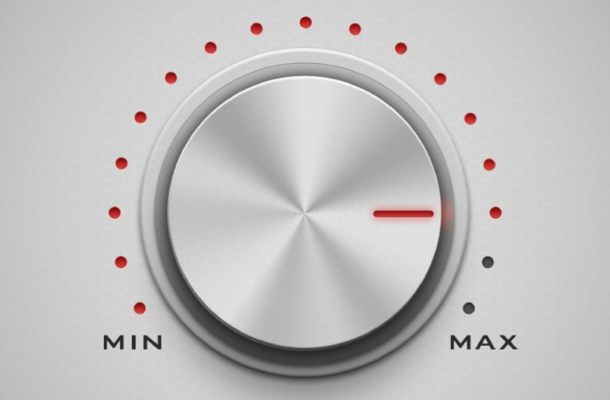
- When life is going well and you want to put in more effort, you dial your efforts up a notch.
- When life is getting a bit messy and you want to make sure that you can juggle everything that is going on, you dial your efforts down a notch (or even 2).
By making small adjustments as the conditions of your life changes, you’re able to keep moving forward and making progress rather than getting stuck or falling off the wagon.
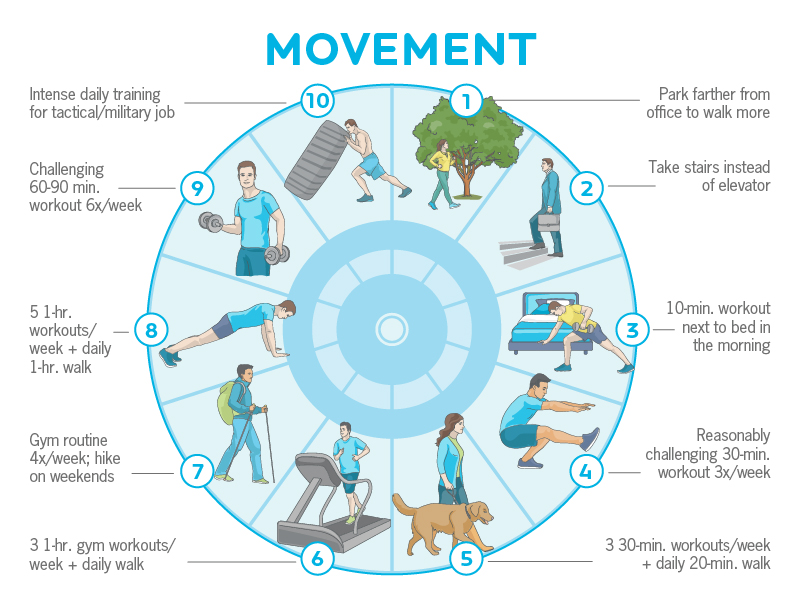
For example, here is an illustration from Precision Nutrition on ways that you might adjust the dial of your movement and exercise efforts:
Scenario 1:
Imagine that you are currently extremely sedentary and doing NO deliberate exercise at all (let’s say 0 out of 10 on the dial)…
- Suddenly you decide to aim for “perfection” and ramp things up to a 7 out of 10 on the dial (4 gym workouts per week and a hike on the weekend). That’s a BIG jump and likely to be unsustainable.
Scenario 2:
Imagine you’ve worked your way up to being a 7 out of 10 on the dial (4 gym workouts per week and a hike on the weekend)…
- Suddenly, life is not going so well so you “fall off the wagon” and drop down to doing NO physical activity at all (0 out of 10). That’s an unnecessarily BIG jump and a lot of lost opportunity for movement.
What could be done differently?
The better strategy for that first scenario would be to adjust the dial up from a 0 to a 1 or 2 by parking a bit further from the office or taking the stairs rather than the elevator. These would be small changes that you can sustain and they will prepare you physically for the next stages coming up.
The better strategy for the second scenario would be to adjust the dial down from a 7 to a 3 or 4 by doing shorter more do-able workouts so that you have more time and energy to deal with whatever isn’t going so well in other areas of your life.
These alternative strategies illustrate the power and effectiveness of thinking on a continuum.
You usually have a range of choices to choose from at any given time. It’s almost never only perfect-or-terrible, black-or-white, good-or-bad, all-or-nothing choices.
But it’s up to you to look for those options.
Here are some more examples:

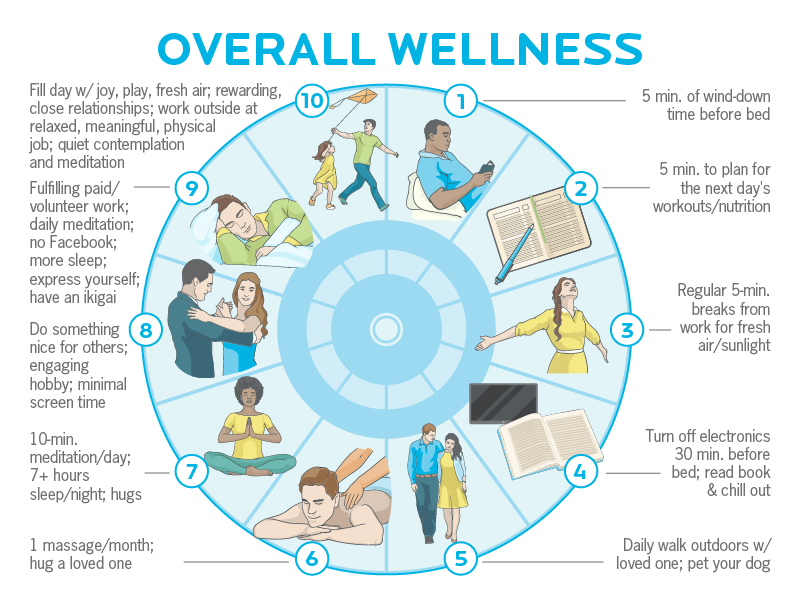
Remember, it’s not the single daily action that transforms your life, it’s the lifetime of consistent and repetitive daily actions that do.
Even when things aren’t going well and you can’t do your healthy habits perfectly, doing something is better than nothing at all and losing all of your momentum.
The key to building a healthy habit is to keep moving forward, even when it’s not perfect, long enough for it to become a habit and a part of your identity.
The aim of the game isn’t to win the game, it’s to stay in the game.
✅ Mission Accomplished?
Fill in the form below once you’re done to keep track of your progress.
<FORM>
You must be logged in to post a comment.