

🎯 Today’s Mission:
To successfully complete today’s mission:
- ✅ XYZ.
- ✅ [OPTIONAL] Share with us, in the <FB Group>, XYZ.
- ✅ Complete the form at the bottom of the page when done.
💡 More Info:
Most people who experience burnout have a LOT going on in their lives.
It’s normal to feel overwhelmed and possibly even paralysed with indecision when trying to figure out how to make things better.
This overwhelm might show up in your life as:
- Constantly jumping from one exercise plan to another, looking for novelty.
- Investigating one diet after the next, convinced you just haven’t found the right one yet.
- Making promises to other people (or yourself) and not following through.
- Avoiding making a decision about something because you feel so overwhelmed.
- Having an all-or-nothing mindset where you feel that if you can’t do something perfectly then there is no point in even trying at all.
You might feel like you are being pulled in all directions, half-attending to everything that’s going on, and struggling to stay focused on one thing long enough to actually make solid progress.
Why do we get so easily distracted?
Distraction vs Traction
Nir Eyal, author of the book “Indistractable”, talks about “distraction” meaning literally “losing traction”, or sliding away from the things that matter to us.
He proposes:
- A distraction is something we do that moves us away from what we really want.
- Traction is an action that moves us towards what we really want.
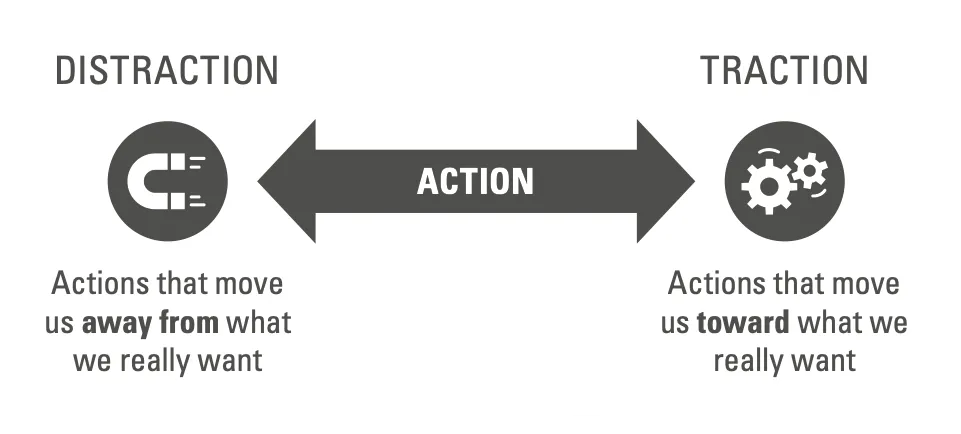
The sneaky thing is that any action can be BOTH a distraction or traction depending on what you intend to do with your time.
For example, checking your work email may feel productive. But, when you really should be focusing your attention on a big project or deadline, you’ll come to regret the time you wasted cleaning out your inbox.
Another example might be how scrolling through social media may feel like it’s offering you a mental break from all of your real-world problems, but it’s still a highly stimulating activity that doesn’t give your brain the much-needed rest and relaxation that it needs.
This is why in today’s modern world of information overload and constant busyness, it’s important to know what to focus on and what to ignore.
Focus Filters
Most people experience tremendous anxiety and depression as a result of being unable to focus.
On the other hand, being able to stay focused and manage distractions well can feel like a superpower.
Implementing an intentional focus filter can help with this.
A focus filter is when you consciously tell yourself, “I’m choosing to focus on THIS right now.”
- If you’re trying to get work done, then focus on that.
Don’t split your attention by trying to counsel your mother-in-law via WhatsApp at the same time.
- If you’re spending quality time with your partner, then focus on that.
Stay present rather than thinking about work while you gaze across the candlelit table.
- If you’re cleaning the house, then focus on that.
Get it done rather than stopping every 5 minutes to check social media.
- If you’re relaxing in bed, then focus on that.
Put your to-do list out of your mind until it’s time to work again so that you can get the most out of your relaxation time.
But deciding on what to focus on is only one part of creating a focus filter.
A focus filter also helps you to identify what might realistically distract you and help you take steps to reduce or eliminate it.
- If you’re trying to get work done…
Maybe schedule a call with the mother-in-law for later after work so that you can give her your full attention?
- If you’re spending quality time with your partner…
Maybe do a “brain dump” with your to-do list before your date so that you get all of your work items out of your head and onto paper for later?
- If you’re cleaning the house…
Maybe log out of social media apps until the cleaning is done?
- If you’re relaxing in bed…
Maybe set a timer for how long you want to relax for without any guilt or worry, and put all thoughts of work away until after that timer is done.
Sometimes we DO need to multitask, but most of the time we don’t. Multitasking certainly shouldn’t be the default mode of operation.
That’s why creating focus filters helps you to build the skills of:
- Deciding in advance where to place your time, energy, and attention.
- Filtering out distractions to stay focused on what you need to be doing right now.
Just like how the harder you train in the gym, the more important sleep and nutrition for recovery become, similarly the busier your life gets, the more important prioritisation and focus becomes.
✅ Mission Accomplished?
Fill in the form below once you’re done to keep track of your progress.
<FORM>
You must be logged in to post a comment.